Balancing home and work life in this pandemic can be a struggle. So many of us transitioned to working from home, quite literally overnight, and even as things have changed and things have started to re-open, the impact of this new normal means many of us continue working from home, either full-time or occasionally. We have shifted our thinking from telecommuting as a perk to a necessity for many people. At the very least, we may need to always have that option for times when we or our families aren’t feeling well or another flu or disease breaks out. Now that we know that we CAN, and sometimes should, work from home, it is likely to be a more common feature of our professional lives.
So what does that mean for work-life balance? Yet another perk that’s become a fixture. We used to talk about work-life balance as a sort of idealism that companies or situations offered. You would choose a certain circumstance because it provided work-life balance.
But now, work-life balance isn’t just a nicety. It’s a necessity. Because our physical work and home lives are quite interwoven.
 As a voice over talent, I’ve been balancing work and home life for over a decade now. I’ve had a home studio since the earliest days of my career. And as my personal life changed, from a single woman living on her own, to a newly married couple, to a mom, I’ve welcomed more people into my home and by extension my work space. I’ve learned a lot about working from home and balancing all those aspects and I have some tips that may help you as you start to settle into this new way of doing life.
What Does Work-Life Balance Mean?
Let’s take a moment and talk about what work-life balance means. As I define it, work-life balance is about your health as you juggle the responsibilities, challenges, joys, and weights of both your professional and personal lives. That health is not only your physical health, but also and especially your mental health as well. To do that, you need to be able to create space that allows you to make the most of both of those realms and to enjoy them for what they are.
Prioritizing Work and Home Life As You Balance
Although we often use the word “balance” to describe this struggle, it may not actually describe it well. It isn’t as though we are using a scale with fifty percent on each side. In order to do our best in each arena, we need to be able to prioritize each. This means giving each realm the time and physical space they deserve.
Making Work A Priority From Home
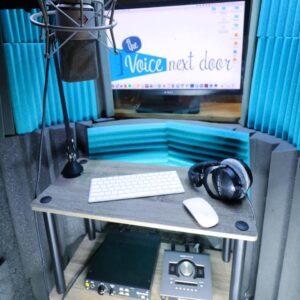
- The first step is seemingly the easiest, but we all are guilty of neglecting it. Set up a designated space to work. It may be a room all to itself. As a voice over actor, for me that means a studio. Maybe you don’t need a whole studio or maybe you don’t have a room to set aside just for work. That’s okay. A closet, a desk, a corner. Anything that can be distinct from other spaces. Make it a habit to use that work space, and not your bed, your couch, the table where you eat, etc. You need to be able to walk away from your work, and preferably to shut a door behind you too.
- Keep a schedule- and stick to it. This one is hard too. With laptops and mobile devices, work can easily meld into all times of the day, and night. But keeping time distinct is an important factor in maintaining balance, so you won’t feel like you are constantly working. Set office hours and publish them. Make sure your colleagues, and your loved ones, know when you are available and when you aren’t.
- And here’s maybe the hardest one of them all. Get dressed for work. We’ve all heard the stories of the new pandemic work clothes, and the horror stories of Zoom meetings gone awry. As professionals, even when working from home, we owe it to ourselves to dress the part. I’m not saying we need to dress to the nines every day. However, putting together an “office wardrobe” can really help. Then you can put on when you go into work, and then change out of when you’re ready to play on the floor with the kids or go work in the garden. It’s a visual cue to everyone about what’s happening next.
Making Home A Priority
An equally important distinction is setting time and space aside for home life. It’s easy to just keep checking emails, writing one more report, or processing one more invoice. But pretty soon, those little moments here and there creep into every hour of your day.
- If you have a family or friends that you live with, make time for them. Time that doesn’t involve a screen or your distractions. Of course, they deserve it. That goes without saying. But the truth is that you deserve it too. And you need it. You will work better and be better.
- Have conversations regularly about what everyone in the home needs, as far as time and space. Be respectful of everyone’s concerns and requirements. And continue to return to those conversations to discuss what is working – and what isn’t.
Physical Health and Mental Health
In light of a global pandemic, our attention is turned to our health and the health of those around us. Balancing our work and home lives can have a direct impact on those factors. When we are taking time away from work, we have time to focus on our health. We can take a deep breath, get some exercise, shop for and eat healthy meals, and laugh more. These are as critical as getting another hour of work in. And especially when there are viruses going around, it’s important that we keep our health up as much as we can, for the sake of everyone around us.
Enjoy The Benefits Of Working From Home
As with anything, there are pros and cons to working from home, but for me, I see a lot of benefits in being in your own space and having some flexibility. As best you can, try to enjoy the advantages of home life. Take a walk around the neighborhood on your breaks, or even take a walk meeting if it’s practical. Step out of the office space and work outside when weather permits.
Overall, just give yourself, and those working and schooling at home with you, some grace. It can be an adjustment for everyone and learning what works for you may take some time. Try something new, adjust and find the perfect schedule and set up that allow you to prioritize your work and home life with balance, efficiency, good health, and joy.
 The single biggest thing you need to make sure to center in your website building is readability. Fonts and fun colors are awesome, but many people find certain color combinations or font choices difficult to read. Sometimes these choices are even headache inducing, especially for older folks. People who have vision correction can also find funky colors and fonts a challenge also. Be sure that you source people on different computers, using different browsers, on mobile and whatever other types you can think of to make sure that everything displays correctly and is easy to follow.
  Most talent have several different demos relating to the various genres of voiceover that they pursue. There are lots of options for players that can integrate with your site to allow the viewing of several of these demos at once. Ranking should be based on what your most hired genre is, or the one that you want to pursue the most. You should also make sure that the highest ranked ones are the professionally produced cuts. Sometimes if you know what you’re doing, you can get away with making a demo for elearning or audiobooks, since those genres are dryer and don’t need music. But you want to make sure your best foot is forward.
  You’d think this would be a given, but there are sites out there where it’s nearly impossible to find out how to contact a particular talent. Don’t hide your contact info at the bottom of the page in faint text, get that info out there loud and proud! If you’re not comfortable with your home or cell number being visible online, there are many services like Google Voice that allow you to create an easy free forwarding number. And it’s no challenge these days to create a forwarding email if you want to give yourself a step removed from any spam you might get. Contact info for your agents can be useful here too if you typically book work through them. Avoid contact forms unless you have a particular need for them, since they seem really impersonal, and you are making your potential client jump through another hoop to reach you.



 Joan is right, and the industry is changing outside of movie trailers quicker than within. TV is it’s own frontier, and it’s doors are a little wider open. “In television many cable channels regularly aim programming at women, and there has been more latitude in the use of female voices. “We’re all trying to make shows that cut through the clutter and stick out,”
  For anyone growing up in the last 60 years or so, computer voices are a part of the early media you consume. The computer voice on Star Trek was female. The robot Nanny in the Jetsons was female. Many folks either had or selected female voices for their GPS. Now, for anyone with an iPhone, Siri, another female voice is a button touch or spoken word away. Alexa is another female standard option, and Cortana is named for a (barely dressed) character from the video game Halo. But why are there so many female computer voices, and why in particular do so many assistant type programs have one?
 Google has an interesting bit of history behind it’s earlier generation of female voices. At the time the company began its signature voice, they originally intended to create both a male and female option. However, an engineer at Google says, “…